
“Which stock is better?” is the question that fills every investing forum. It is also the wrong question, because the honest answer is usually: better for whom?
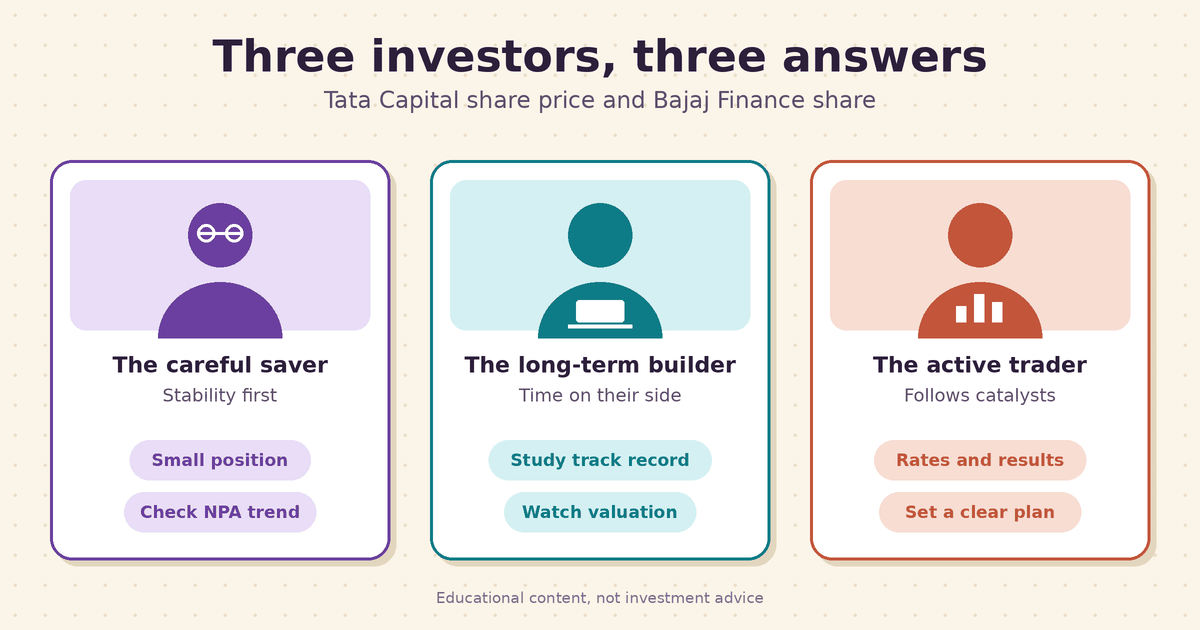
A retired teacher, a 26-year-old software engineer, and a small business owner can all look at the same two stocks and reasonably choose differently. So instead of declaring a winner, let’s walk through three investors and see how the Tata Capital share price and the Bajaj Finance share might fit each of them.
The two companies in a minute
Both are NBFCs, which means they lend money and earn from the gap between their borrowing costs and the interest they charge. Beyond that, their stories differ.
Tata Capital is the flagship financial services arm of the Tata Group and a subsidiary of Tata Sons. It lends across categories such as home loans, car loans, and business loans. It listed on the stock exchanges on 13 October 2025 at ₹330, after a public issue of about ₹15,500 crore. So it has now been listed for roughly a year, which is still a short record compared with older names.
Bajaj Finance sits within the Bajaj Finserv group and is best known for consumer finance: EMI financing for everyday purchases, personal loans, loans for small businesses, and fixed deposits. It has been listed for many years, so there is a deep history of results to study.
Investor one: the careful saver
Meet Meena, a 58-year-old school teacher. She wants her money to grow slowly and does not enjoy sleepless nights over market swings.
For someone like Meena, the main concern is stability. Lenders can be volatile, because their fortunes depend on interest rates, borrower health, and regulation. A stock that rises quickly can also fall quickly.
If she considers either stock, a few habits would help her:
- Keep the amount small relative to her overall savings.
- Prefer the company where she can study a longer track record, because that shows how it behaved in tougher years.
- Check the dividend history and loan quality before anything else.
For her, the better question may be whether an individual lending stock belongs in her plan at all, or whether a diversified fund would suit her temperament better. There is no shame in that answer.
Investor two: the young long-term builder
Now meet Arjun, 26, a software engineer who invests monthly and will not need the money for fifteen years or more.
Arjun has time on his side, which changes the equation. He can tolerate rough patches because he has years to recover from them. For him, the question is which company has more room to grow and whether he understands how it earns.
Bajaj Finance gives him a long record to analyse: how it grew, how it handled credit stress, and how its margins moved. The thing to keep in mind is that a strong history is often already reflected in the price, so the valuation deserves a close look.
Tata Capital gives him a newer story with a trusted parent group, plus the chance to watch how it develops over time. The trade-off is less history to lean on, so he would need to rely more on recent results and management commentary.
Arjun might reasonably split his attention between both while keeping each position modest. What he should avoid is investing a large sum because a friend sent him a “hot tip”.
Investor three: the active, informed trader
Finally, meet Farah, who runs a small business and follows markets closely. She reads quarterly results, tracks news, and is comfortable with price swings.
Farah’s focus would be catalysts: what could change the numbers soon. For both companies, that means watching:
- Interest rate moves, which affect borrowing costs and margins.
- Asset quality, meaning how many loans turn bad.
- Loan growth, which shows demand for credit.
- Regulatory announcements from the Reserve Bank of India.
- Integration and strategy updates, especially at Tata Capital, where the combination of its vehicle finance business is part of the story.
Active investors often get caught on timing, though. A price that feels cheap after a fall can keep falling, and one that looks expensive can keep rising. Farah’s best protection is a plan: a clear reason to buy, a point where she would reconsider, and a limit on how much one stock can matter.
What every investor should check, whatever their style
No matter who you resemble, these basics apply:
Valuation, not price. A lower share price does not mean a cheaper company. Compare price-to-earnings and price-to-book ratios with the company’s own past and with similar lenders.
Loan quality. Look at gross and net NPA trends in each quarterly report. Rising bad loans are an early warning sign.
Profitability. Net interest margin, return on equity, and return on assets tell you how well the company turns lending into profit.
Concentration. Banks and NBFCs often rise and fall together. If you already own several financial stocks, adding more may not spread your risk.
Up-to-date data. Always use a current, reliable source. Prices and ratios change every trading day, and screenshots go stale fast.
A quick comparison
| Tata Capital | Bajaj Finance | |
|---|---|---|
| Time on the stock market | About a year (listed October 2025) | Many years |
| Parent | Tata Group | Bajaj Finserv group |
| Known for | Diversified lending, retail and vehicle finance | Consumer finance, SME loans, broad product mix |
| Easier to study | Recent results and strategy | Long performance history |
| Be careful about | Limited track record | Expectations already priced in |
So, which one should you pick?
Here is the honest summary. If you value a long history and want to study how a business behaved across many cycles, Bajaj Finance offers more to examine. If you like the idea of a diversified lender with a well-known parent and you accept that its listed record is still young, Tata Capital is worth following.
Neither choice is right for everyone, and neither is risk-free. The best pick is the one you understand, can afford to hold through a bad year, and have researched with up-to-date numbers.
Final thoughts
The Tata Capital share price and the Bajaj Finance share are just two windows into the lending business. What you see through them depends on your age, goals, and temperament. Know why you are investing, read the numbers, and let your plan guide you rather than the daily ticker.
Disclaimer: This article is for educational purposes only and is not investment advice. Investments in the securities market are subject to market risks. Please read all related documents carefully and consult a SEBI-registered advisor before investing.


